 |
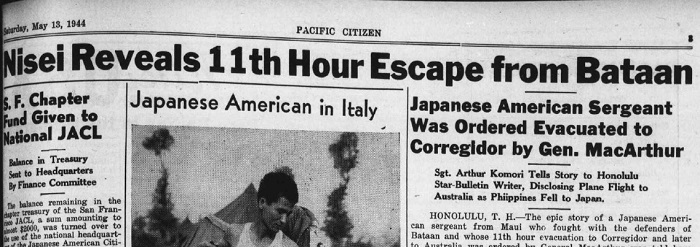
Nisei Reveals 11th Hour Escape from Bataan
Japanese American Sergeant Was Ordered Evacuated to Corregidor by Gen. MacArthur
Sgt. Arthur Komori Tells Story to Honolulu Star-Bulletin Writer, Disclosing Plane Flight to Australia as Philippines Fell to Japan.
Honolulu, T. H. - The epic story of a Japanese American sergeant from Maui who fought with the defenders of Bataan and whose 11th hour evacuation to Corregidor and later to Australia was ordered by General MacArthur was told here recently by Technical Sergeant Arthur Komori in an exclusive interview with Lawrence Nakatsuka of the Honolulu Star-Bulletin. The interview was cleared by army authorities for publication.
Nakatsuka described Sgt. Komori as the "only Hawaii-born soldier of the United States army known to have escaped from the Philippines after the enemy's invasion."
"The stocky 28-year old Maui-born soldier lived through three months of jungle hell on Bataan, then was ordered evacuated to Corregidor the day before the battered peninsula fell. After five days on the Rock, he was flown out to Australia and safety, 2,000 miles away," Nakatsuka reported.
Sgt. Komori was attached to General MacArthur's headquarters in Australia for two years before being ordered back to an army base on the mainland for temporary duty. He has since returned to the south Pacific battle area.
With some reluctance, "like talking about a bad dream," Sgt. Komori narrated his story to Nakatsuka:
"I am a 'nisei' - an American of Japanese ancestry - and you know what the Japs would have done to me if they caught someone of their own race fighting against them on Bataan.
"That's why I carried a .45 automatic with me all the time I was on Bataan. I was prepared for the worst. For a long time I had made up my mind that I would fight to the end and, if necessary, blow my brains out rather than be captured. I had heard about Jap atrocities.
"I owe my life to the evacuation order from Gen. MacArthur which came to me the day before Bataan fell. I don't like to think what would have happened if the order hadn't arrived on time.
(Sgt. Komori recalled that he was attached to the U.S. air forces headquarters in Manila at the time of the outbreak of war.)
"When Manila was threatened our headquarters moved to Corregidor, but they bombed the hell out of us there too.
"Their bombers blasted our thick concrete barracks in which we were living and they strafed us as we ran into the bushes for cover.
"After a couple of days I moved over to Bataan on a barge and from then on until April 8, the day before Bataan gave up its heroic fight, I lived in hell with thousands of other American and Filipino defenders in the jungles on that peninsula.
"At first, we had some army chow which wasn't so bad but later we had only rice and gravy for a month.
"When tomatoes and pickles ran out, we had to boil young tree leaves as substitute for greens. For meat we hunted monkeys.
"I didn't eat monkey meat at first, but one day when I got really hungry and saw it being broiled over a fire - it smelled awfully good - I ate some of it. It tasted like roast turkey and reminded me of the turkey dinner I had on Corregidor on Christmas Day.
"We also had mule meat, horse meat and carabao. All tasted OK.
"We were constantly bombed from the air, and foxholes became the safest places for us. Flies made a mess of things and they got into the food, what little we had left.
"I got dysentery for two or three days at a time. Like many of the other fellows I was in a weakened condition and my resistance was low.
"We became exhausted from day and night bombings which kept us awake, and made sleep almost impossible. We were short of food and worked ceaselessly.
"I was attached to the Philippines department headquarters and one of my jobs was to move metal cabinets around in the thick jungle. It was tough going.
"We held out on Bataan until April 8. There was death, disease and suffering on all sides. I had somehow kept up my health, even though I was weak from lack of sleep and food.
"Then I was ordered to Corregidor. I made the trip to the rock on a launch with two colonels.
"It was broad daylight. When we got halfway over, a Jap bomber dropped a string of bombs not far behind us, but we luckily escaped unharmed.
"I lived in the tunnel on Corregidor until the morning of April 13 when I was flown out by orders of Gen. Wainwright, for whom I had done some translation work on Bataan.
"The plane was an old army trainer, a biplane seating four of us. It had crash landed on the island earlier to bring medical supplies.
"The old biplane was actually one-third of the entire U.S. air force in the Philippines at that time. There were only three planes in our hands that were in flying condition. It was a wonder that our rattling plane flew at all.
"The 'air strip' was a rocky beach and we were lucky to get the plane off the ground. I guess plane hadn't hit a rock which bumped the plane about 50 feet into the air to help in the take-off.
"I alternated with the pilot in flying the old crate to Panay, some 250 miles south in the central Philippines. My previous flying experience came in handy, and I was thankful I had my CAA (Civil Aeronautics Authority) pilot's license which I received in Hawaii in 1941.
"We landed at Panay on April 13. Three days later the Japs occupied the islands.
"A Mitchell medium bomber flew us to Mindanao, 250 miles further south. We landed on a secret landing strip which the Japs had located and bombed that day. The field was still blazing when we landed.
"Another Mitchell bomber which had to have one of its engines overhauled, flew us out at midnight for Australia. Incidentally, both Mitchells were in the raids on Manila, Cebu and Davao, originating from Australia under Brig. Gen. Ralph Royce.
"It was a long, nonstop flight from Mindanao to Australia which took about 15 hours. We had to hedge-hop 25 feet above the sea and at other times dodge among the many small islands to escape detection by the Japs. Otherwise the trip was uneventful.
"Looking back now I'm surprised I wasn't shot at accidentally by our own men during those hectic days on Bataan and Corregidor.
"My speech and my American ways must have convinced them I was a real American and not a camouflaged Jap posing as an American soldier."
Pacific Citizen
Salt Lake City, Utah
Saturday, May 18, 1944
Page 1

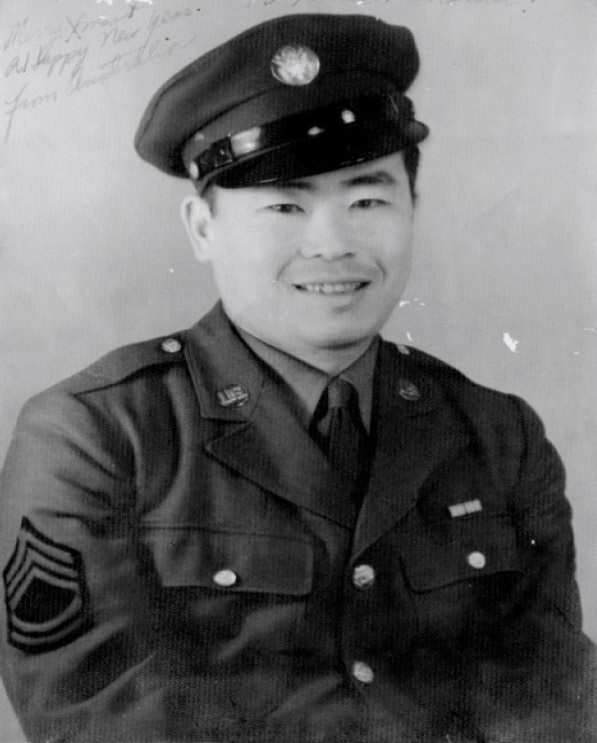 Arthur Komori |
US Army
Arthur Komori enlisted in the Corps of Intelligence Police (CIP) as a civilian agent at Fort Shafter, Hawaii, in March 1941, nine months before the US entered World War II. Soon he was made a DEML [Detached Enlisted Men’s List1] Sergeant and sent to the Philippines with Richard Sakakida (HOF 1988) to be an undercover agent. Their mission was to locate Japanese subversive activities, and their knowledge of Japanese language and culture made them excellent agents.
| 1Detached Enlisted Men’s List was comprised of persons in duties which did not fit well into the description of any branch. It included enlisted assistant instructors at West Point, enlisted orderlies for general officers, counter intelligence and intelligence specialists, Office of Strategic Services (OSS), etc. The “detached” meant that they were assigned to one command but assigned duties with another. |
After the Japanese bombed Pearl Harbor and invaded the Philippines, Komori provided valuable interpretation services. However, his Japanese ancestry and his elaborate cover story made him a suspect and both he and Sakakida were arrested and put into Bilibid Prison on suspicion of espionage. Both men maintained their cover stories until they were released by the US government. Komori also worked with MSG Lorenzo Alvarado (HOF 1988), interrogating prisoners and gathering information. Just prior to the fall of Bataan, he was one of the few men flown to Australia with other valuable personnel to avoid captivity.
Once in Australia, Komori was assigned duties with the Allied Translator and Interpreter Service. He managed to get back into the Counter Intelligence Corps (CIC, formerly the CIP) but was sent back to the United States in 1943. His duty was to orient the Nisei (2nd generation Japanese-Americans) at Camp Savage, Minnesota, on the situation in the Pacific and boost morale. In December 1944, Komori went back to the Pacific Theater and worked with the Australian Broadcasting Company under the Department of Information. After World War II, he worked as one of the first undercover agents in Occupied Japan. He was transferred back to Honolulu as a civilian agent investigating Communist agitators and
Japanese leaders still disseminating pro-Japanese propaganda. Eventually, he was assigned instructor duty at the Intelligence School at Fort Holabird but resigned from the Army when General MacArthur was released from active duty. Komori transferred to the Air Force Reserve as a Captain in 1952. He was a civilian teacher from 1952 to 1956, went to law school at night at the University of Maryland, and earned his law degree. He returned to Hawaii in 1956 to practice law.
CWO Komori was inducted into the Hall of Fame in 1988. He passed away in 2000.
